


Why the candidate experience — not the algorithm — decides whether AI recruitment wins or loses you talent
Based on Robertson & Company candidate survey data · October 2025 – September 11, 2026
Executive summary
Artificial intelligence is now embedded in how candidates are screened, matched, and interviewed. The strategic question for HR and Talent Acquisition leaders is no longer whether to use it, but whether candidates will accept it. Our survey data delivers an uncomfortable but useful verdict: candidates are not broadly skeptical of AI — they are sharply divided, and what divides them is almost entirely within recruiters’ control.
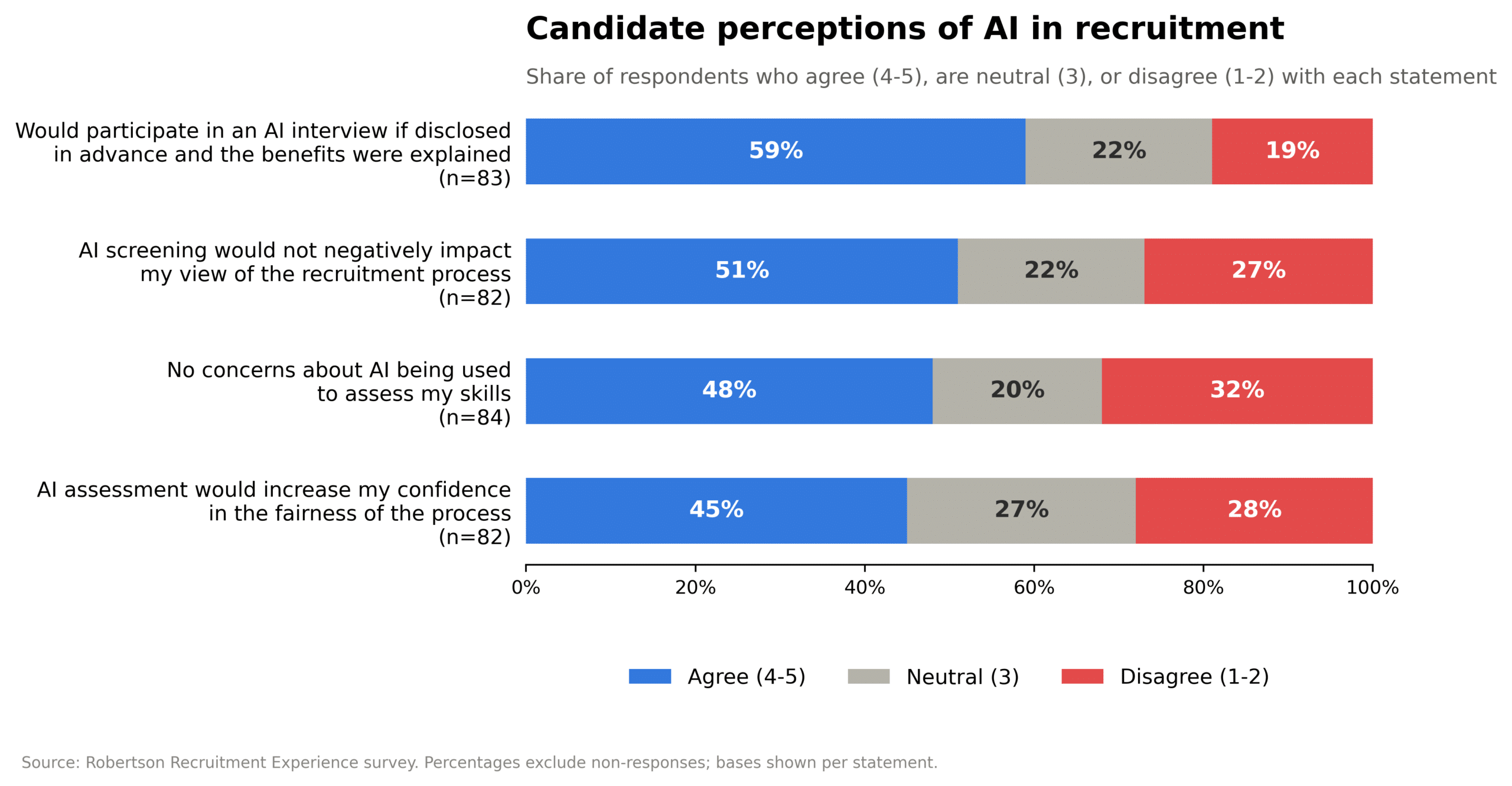
Candidates are split down the middle. Roughly 60% of candidates would willingly take an AI interview — but only on two conditions: that it is disclosed in advance, and that they are told what is in it for them. On the second condition many recruiters and employers are falling short. Only 60% of candidates who completed an AI interview felt its benefits were ever explained to them, and that measure remains the weakest point of the AI experience. It is also the simplest, inexpensive action to take. In this data, whether the benefits were explained tracks almost one-to-one with whether the experience was positive.
Crucially, where candidates turned against the recruitment process, the data shows the villain is rarely the AI itself. It is silence — no follow-up, contradictory automated messages, and the sense of being processed rather than considered. The data puts numbers to this: candidates rate the people they meet highly, but closing the loop is the single lowest-scoring question in the entire survey, and timely communication is the strongest driver of whether a candidate will recommend the employer at all. AI did not create these failures, but at scale it can amplify them. Handled well, the same technology measurably lifts employer brand; handled carelessly, it erodes the willingness of good people to recommend employers, reapply, or say yes.
Key Take-Aways
- Treat candidate experience as the deciding variable in AI hiring ROI — not a soft add-on.
- Close the “what’s in it for me” gap first; it is the highest-return, lowest-cost fix.
- Keep a human visibly in the loop — especially at rejection and follow-up, where employer reputation is made or lost.
- Measure candidate sentiment continuously and tie it to brand and conversion metrics leadership already tracks.
The Numbers that Matter
| Candidate measure | Result | What it tells us |
|---|---|---|
| Would take an AI interview if it is disclosed up front and the benefits are explained | 59% | The addressable opportunity — most candidates are willing, on clear conditions. |
| Felt the benefits of the AI interview were explained to them | 60% | The weakest AI-experience measure and the biggest lever recruiter’s control. |
| Received a clear outcome — a thank-you and an explanation of why they were or weren’t selected | 43% | The lowest-scoring recruitment process measure in the entire survey: with the greatest impact on employer brand. |
| Said the process positively changed their view of the employer | ~50% | Versus ~24% negatively — experience moves brand in both directions. |
| Would recommend the employer to a friend or colleague | Net +20 | Solidly positive but still trails intent to accept an offer (Net +36) — advocacy is the last gap to close. |
Figures are directional and drawn from a candidate survey with a modest AI-interview subgroup; see Methodology. Percentages reflect candidates who agreed or strongly agreed unless noted.
- Why this belongs on the executive agenda
Recruitment technology decisions are usually justified on efficiency: faster screening, more applicants assessed, and shorter time to hire. While the first two gains are real, shorter time to hire can only be realized if candidates complete the process and leave willing to accept, reapply, and advocate. The candidate experience is therefore not downstream of the AI investment — it is the mechanism through which that investment pays off or fails.
The stakes are asymmetric. A candidate who has a good experience becomes a quiet ambassador. A candidate who has a bad one becomes a public detractor — and every abandoned application, rejected offer, or unanswered follow-up is a small, compounding withdrawal from the employer brand. In a competitive talent market, that brand is a balance-sheet asset.
- What the data shows
2.1 The market is split, not skeptical
The dominant pattern across nearly every question is polarization. Candidates do not cluster around “unsure”; they cluster at both ends — a large group strongly positive about AI in hiring, and a substantial minority strongly opposed. This split holds consistently across age groups, which tells us the divide is not generational and will not simply age out. It is driven by experience and information, both of which we shape.
This matters because attitude predicts behavior. Candidates who are comfortable with AI are markedly more likely to say they would participate in an AI interview and to trust the fairness of the outcome — the two move together closely in the data. Sentiment is not decoration; it is a leading indicator of pipeline conversion.
 2.2 The biggest gap is explaining “what’s in it for me”
Candidates increasingly know that AI is being used — around six in ten feel clearly informed — but they still do not know why it benefits them. Fewer than half felt anyone explained the benefits, making this the weakest measure of the AI experience. Absent that explanation, AI reads as impersonal or arbitrary, and a neutral tool becomes a negative signal. The data is emphatic about how much this matters: whether the benefits were explained is almost perfectly aligned with whether the candidate found the experience positive — the two move together more tightly than any other pair of measures in the survey.
This is the most encouraging finding in the report, because it is entirely fixable with communication rather than technology. The benefits are genuine and worth stating plainly to every candidate: AI interviews are available around the clock and remove scheduling and travel friction; results and feedback come back faster; and a well-designed AI screen applies the same questions and criteria to every applicant, widening the funnel so that more qualified people are seen rather than fewer.
2.3 When candidates turn negative, the cause is usually silence — not AI
Candidate feedback via open-text responses are the most instructive part of the survey. The harshest feedback is rarely about artificial intelligence at all. It is about being ignored: no rejection, no follow-up to direct questions, contradictory automated emails advancing and rejecting the same person, and the feeling of interacting with a system that shows no acknowledgement of the candidate’s time.
“I received so many automated emails telling me I was both rejected and advancing.” — Survey respondent
“I felt as if I am talking to the wall. No emotion, no empathy.” — Survey respondent
The data quantifies the pattern. Candidates rate the humans they meet highly — about three-quarters found interviewers friendly and respectful, the top-scoring item in the survey. But the lowest-scoring item of all is closing the loop: only about half of candidates received a thank-you and an explanation of why they were or were not selected, and more than a third said they did not. That single failure is not cosmetic — timely communication is the strongest driver in the entire dataset of whether a candidate will recommend the employer, outweighing almost every other factor measured.
The lesson for leadership is precise: AI is not the reputational risk — automation without human accountability is. The same candidates who praised the process pointed not to the technology but to people. Named recruiters who prepared them, communicated clearly, and treated their time with respect produced the strongest positive impressions in the entire dataset.
“The interview process was smooth and professional, which gave me a very positive impression of the company and the role.” — Survey respondent
2.4 Experience translates directly into employer brand
The perception data makes the brand link explicit rather than theoretical. Among candidates who assessed the effect, roughly half said the experience improved their view of the employer, while about a quarter said it worsened it — the process moved brand perception in both directions, and did so for most people who engaged with it.
The advocacy metrics locate the soft spot. Willingness to recommend the organization as an employer is solidly positive, but it still trails candidates’ willingness to accept an offer. In other words, candidates are ready to take the job, yet not quite asready to become public advocates, and advocacy is precisely what a differentiated employer brand runs on. Positive interview experiences and willingness to recommend move together closely in the data, so the remaining gap is closable through the same levers described below.
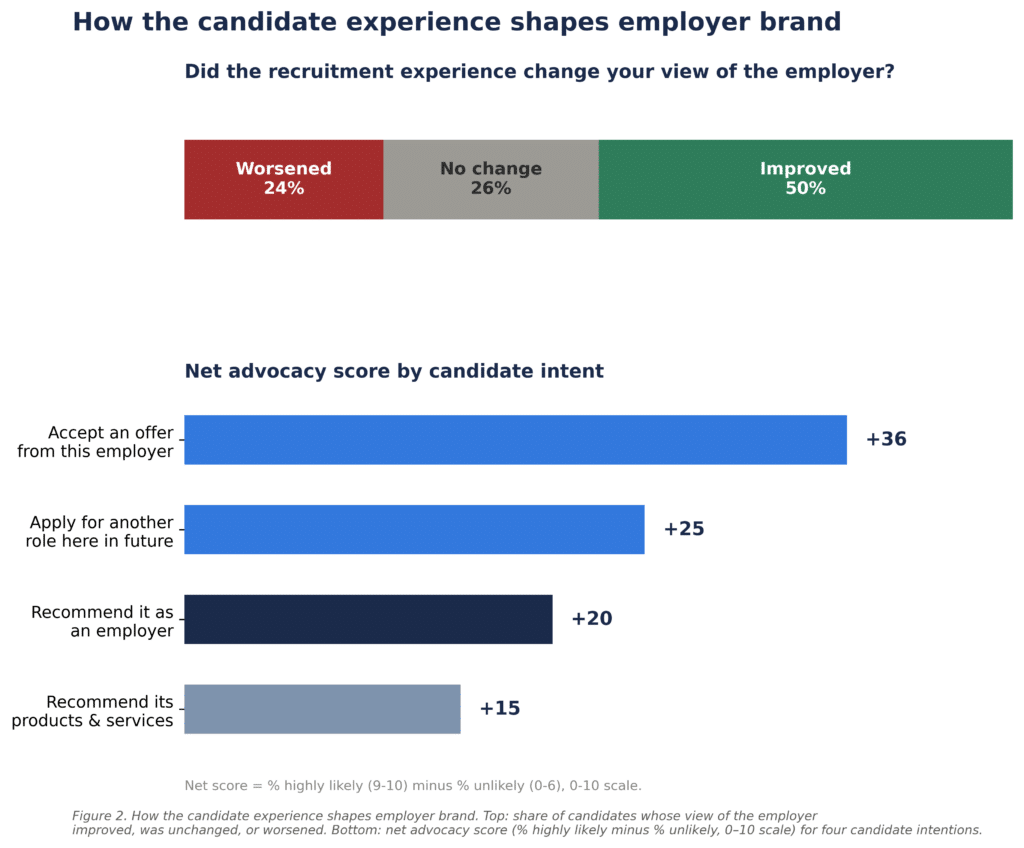 Figure 2. How the candidate experience shapes employer brand. Top: share of candidates whose view of the employer improved, was unchanged, or worsened. Bottom: net advocacy score (% highly likely minus % unlikely, 0–10 scale) for four candidate intentions.
- What good looks like: four actions for HR and Talent Acquisition leaders
Drawing on this data and Robertson’s operating experience with AI interviewing, four actions will help you deliver a positive experience that keeps top candidates engaged throughout the recruitment process.
1 — Make transparency the default, in writing and up front
Candidates should know AI is involved, which stage it touches, and how their data is evaluated before they are invited to participate — communicated in writing and reinforced verbally by recruiters wherever possible. Disclosure is not a compliance nicety; it is what prevents the surprise that causes good candidates to disengage, and it earns you the right to explain how AI recruitment tools benefit them.
2 — Sell the benefits, not just the fact
This is the simples, highest-return action recruiters and employers can implement. At every stage in the recruitment process, candidates should hear plainly what AI does for them: complete the interview on their own schedule, from anywhere, with no travel; get faster feedback; and be assessed on the same criteria as everyone else, with more applicants seen rather than fewer. Scripting these three benefits into recruiter communications and automated messages is a low-cost change that targets the largest gap observed in our research.
3 — Keep a human visibly in the loop
Closing the loop with candidates is the lowest-scoring item in the survey. Communication is the strongest single driver of whether a candidate will recommend an employer — so this is not a courtesy, it is the most impactful action an organization can take to improve their employer brand. Two guarantees address most of the damage: every candidate receives a clear, timely outcome — including a real rejection with a reason — and every direct question from a candidate reaches a human who answers. AI should expand recruiter capacity for exactly this kind of human contact, not replace it. Several survey respondents also indicated accommodations should be made for disabilities; with an easy route to request adjustments to an AI interview where necessary to ensure equal access and fairness.
4 — Design for warmth, and measure continuously
AI interface quality shapes perception. Clear instructions, practice questions, and a short demo of how the platform evaluates answers measurably reduce anxiety; the more the experience feels human, the better it lands. Candidate sentiment needsto be tracked as an ongoing leading recruitment metric — reviewed alongside other recruitment KPIs — so that friction points are caught and addressed early and the process keeps improving as expectations rise.
- Methodology and limitations
Findings draw on Robertson & Company’s Job Appeal and Recruitment Experience surveys, fielded to all candidates in our database between October 2025 and September 11, 2026. The surveys capture both AI-specific questions and a broader set of recruitment-experience measures — communication timeliness, respect for the candidate’s time, consistency of the role as described, fairness, and whether candidates received a clear outcome. Respondents (n=309) rated their experience and perceptions on standard agreement and likelihood scales and provided open-text feedback. One limitation should be noted. The subgroup of respondents who completed an AI interview in the survey is modest, so insights specific to that experience are directional rather than definitive.
- Conclusion
AI is transforming recruitment, but our data is unambiguous about where the risk and the return actually sit: not in the algorithm, but in the experience wrapped around it. Candidates are willing — most of them, on clear and reasonable conditions. They ask to be told the truth up front, to understand what AI does for them, and to be treated by a human being when it counts. Every candidate who abandons the process because AI was unexplained, or who leaves as a brand detractor because no one followed up, costs an organization in two ways: it reduces the talent pipeline and the employer brand. The interventions above are almost entirely communication and process discipline rather than technology spend — which makes candidate experience the highest-return, lowest-cost improvement available to any organization already investing in AI recruitment.
Organizations that meet candidates’ expectations with respect to the use of AI in the recruitment process will convert more talent, protect their brand, and realize the efficiency gains AI was adopted to deliver. Those that automate without accountability will spend the same money to erode the very asset they were trying to build.

