
It looks like you are in the United States. Are you looking for Robertson and Company's U.S. site?
Categories
Uncategorized @en-ca

Human Touch in Recruitment

After more than 25 years in recruitment, one thing has become very clear to me: technology changes, but people don’t.

I’ve worked through every major shift our industry has experienced—from paper resumes and fax machines to ATS platforms, AI sourcing tools, automation, and predictive analytics. Today, we can identify talent faster than ever before, automate administrative tasks, and generate hiring data with the click of a button.

All of that is valuable.

But none of it replaces the human connection that sits at the heart of successful hiring.

Throughout my career, I’ve led recruitment teams supporting everything from specialized professional hiring to large-scale recruitment programs involving hundreds of hires. Technology helped us scale. It helped us move faster. It helped us become more efficient.

What it didn’t do was build relationships and trust.

When I think about the candidates who accepted offers and stayed with organizations long-term, it wasn’t because an automated workflow impressed them. It was because someone took the time to understand what mattered to them. People want to know they are more than a resume. They want to know that someone understands their goals, concerns, motivations, and aspirations.

One of the biggest mistakes organizations make is believing they must choose between technology and human interaction. The reality is that great recruitment requires both. Automation should handle repetitive tasks so recruiters can focus on the work that creates value: building relationships, assessing fit, advising hiring leaders, and creating exceptional candidate experiences.

I’ve seen organizations invest heavily in technology only to discover that candidates still disengage from the process. Technology doesn’t create engagement. People remember how they were treated. They remember whether they felt respected and whether someone genuinely listened.

Technology can help identify skills, qualifications, and experience, but it cannot evaluate the human nuances that often determine whether someone will succeed in a role. Adaptability, emotional intelligence, leadership presence, communication style, team dynamics, and alignment with an organization’s culture are often revealed through conversations and professional judgment. Some of the best hires I’ve seen over the years weren’t perfect matches on paper. They succeeded because they brought qualities that no algorithm or screening tool could fully capture.

I learned this lesson firsthand during a large hiring initiative. We had a candidate who checked every box. The role was strong, the compensation was competitive, and the opportunity offered significant career growth. Yet the candidate hesitated.

Instead of focusing on selling the opportunity, we focused on understanding the individual. What emerged was that compensation wasn’t the primary concern. Leadership support, flexibility, and long-term growth were. Once those concerns were openly discussed, the decision became much easier, and the candidate went on to have a successful career with the organization.

That experience reinforced something I’ve seen repeatedly throughout my career: candidates rarely make decisions based solely on a job description or compensation package. They make decisions based on whether they feel understood and valued.

AI and automation will continue to reshape recruitment, and they should. The opportunity for talent acquisition leaders is not to resist technology but to use it strategically. The organizations that will win in the years ahead will be those that use technology to create more capacity for human connection—not less.

After 25 years in this profession, I remain convinced that recruitment is ultimately about people helping people make important career decisions. Technology can support that process, but it cannot replace it.

The human touch remains one of the most powerful competitive advantages in hiring, and organizations that balance innovation with authentic human connection will continue to attract, engage, and retain exceptional talent.

By Ted Pierni
Head of Delivery | Robertson & Company

Ted Pierni is Head of Delivery at Robertson & Company. With more than 25 years of experience in Talent Acquisition, RPO, workforce strategy, and recruitment leadership, he writes about emerging trends shaping the future of hiring.


Categories
Uncategorized @en-ca

Beyond the Resume: Why Skills-Based Hiring is Reshaping Talent Acquisition

Over the last year, I’ve noticed a real shift in conversations with hiring leaders. Five years ago, most discussions started with job titles, industry pedigree, and “must-have” company experience. Today, more organizations are beginning to ask a different question:

Can this person do the work, adapt, and grow within our environment?

That may sound simple, but it represents a meaningful evolution in hiring.

After more than 20 years in Talent Acquisition across banking, consulting, RPO, and high-volume enterprise environments, I’ve seen how easy it is for organizations to over-index on resumes that “look right” on paper. We become conditioned to search for familiar titles, recognizable employers, and perfectly linear career paths because they feel safer and easier to validate.

The problem is that this approach often filters out exceptional talent before they ever get a chance.

What I’m seeing now is a stronger focus on skills, transferable experience, and the broader capabilities that support long-term success. Now that many organizations have dedicated teams responsible for competency frameworks and workforce design, recruiters are increasingly being asked to think beyond matching resumes to job descriptions.

And honestly, I think that’s a good thing for our profession.

I don’t believe job titles are irrelevant. Experience still matters. Context still matters. But titles alone are often poor predictors of performance or potential. Some of the strongest hires I’ve seen throughout my career came from unconventional backgrounds. They succeeded because they demonstrated adaptability, curiosity, communication skills, leadership potential, accountability, resilience, and the ability to learn quickly.

Those qualities may not always jump off a resume immediately, but they matter.

One of the biggest advantages of skills-focused hiring is that it broadens access to talent pools that were previously overlooked. Recruiters are under enormous pressure right now. Many markets remain competitive, specialized talent remains difficult to secure, and organizations are trying to balance speed, cost, quality, and retention all at once.

Continuing to search only for candidates with identical backgrounds to previous hires narrows the funnel dramatically.

The best recruiters today are learning how to identify transferable capability, not just direct industry matches.

Instead of asking:
“Has this person done this exact job before?”

We start asking:
“Do they have the core skills, mindset, and capability needed to succeed in this environment?”

That shift opens doors to internal mobility, career changers, newcomers, adjacent industry talent, and candidates whose experience may not fit perfectly into traditional boxes, but whose potential is undeniable.

I’ve also seen another important benefit: stronger long-term hiring outcomes.

When organizations clearly define what success looks like in a role, recruiters and hiring managers become more aligned. Interview conversations become more structured. Assessments become more objective. Feedback becomes more meaningful. And perhaps most importantly, organizations begin hiring for sustainability and growth rather than short-term comfort.

Too often, hiring leaders unconsciously search for familiarity because it feels like the “safe bet.” But hiring based purely on familiarity can unintentionally reinforce sameness and cause organizations to miss high-potential talent sitting right in front of them.

Not every organization has perfected this approach yet. Many are still early in the journey. I continue to see hiring processes that are either too rigid or so over-engineered they become difficult to apply consistently. Recruiters also continue to face the challenge of educating hiring leaders who still default to prestige markers or highly specific experience requirements.

But overall, I believe this shift is healthy for recruiting.

As recruiters, we sit in a unique position. We influence not only who gets hired, but how organizations define talent in the first place. That’s a responsibility I think we sometimes underestimate.

The recruiters who will stand out over the next several years won’t simply be resume matchers. They’ll be talent advisors who can identify transferable skills, assess potential thoughtfully, challenge assumptions respectfully, and guide hiring leaders toward broader and more strategic thinking.

In many ways, this is bringing recruiting back to what it was always supposed to be about: understanding people, not just profiles.

And honestly, I think that’s a good thing.

By Ted Pierni
Head of Delivery | Robertson & Company

Ted Pierni is Head of Delivery at Robertson & Company. With more than 25 years of experience in Talent Acquisition, RPO, workforce strategy, and recruitment leadership, he writes about emerging trends shaping the future of hiring.

Categories
Uncategorized @en-ca

What Candidates Really Value 

One of the things I enjoy most about working in RPO is that we have the opportunity to hear directly from candidates every day. We also have the ability to step back and look at the bigger picture. 

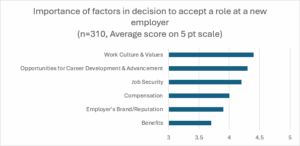
Recently, we surveyed candidates to better understand what influences their decision to accept a new opportunity. The results reinforced something I’ve been seeing for quite some time. 

Source: Roberston & Company, Data as of June 11th, 2026, Job Appeal Survey n=310 respondents

Compensation matters. 

It just isn’t the whole story. 

Our survey found that work culture and values ranked highest, followed closely by career development opportunities and job security. Compensation remained important, but it wasn’t the number one driver. Candidates are thinking more broadly about where they want to build their careers. 

That reflects the conversations recruiters are having every day. 

After more than 25 years in Talent Acquisition across banking, consulting, and RPO, I’ve learned that candidates rarely make career decisions based on salary alone. They’re evaluating whether they’ll be supported, whether they can grow, and whether they’ll enjoy working with the people around them. 

Those are much harder things to measure than years of experience or technical skills. 

It’s also where recruiters continue to make a real difference. 

AI has transformed many parts of recruitment. It can search faster, summarize resumes, identify patterns, and help recruiters become more efficient. I use these tools myself, and I believe they’ll continue to improve. 

What AI can’t do is build trust during a conversation or recognize the hesitation in a candidate’s voice when they talk about a previous manager. It can’t fully understand whether someone is motivated by flexibility, stability, leadership, learning opportunities, or purpose. Those insights come from listening, asking thoughtful questions, and building relationships over time. 

I’ve written previously about the importance of maintaining the human side of recruitment, even as technology continues to evolve. This survey reinforces why that matters. 

If recruiters only focus on matching resumes to job descriptions, we’ll miss the conversations that explain why someone is actually considering a move. 

I’ve also seen organizations lose exceptional candidates because communication broke down. Delays, inconsistent messaging, or unclear expectations often create uncertainty long before compensation becomes an issue. 

Candidates today expect transparency. 

They understand that hiring takes time. What they don’t want is silence. 

That’s why I believe candidate experience has become a competitive advantage. Every conversation, every follow-up, and every expectation we set contributes to how candidates view an organization. 

As recruiters, we’re often the first relationship a candidate has with a company. We influence how they experience the hiring process and how they perceive the employer behind it. 

Technology will continue to change how we recruit. I don’t see that slowing down. 

What won’t change is the importance of understanding people. 

The recruiters who will continue to stand out are those who combine technology with curiosity, empathy, and good judgment. They’ll use AI to become more efficient while spending more time having better conversations. 

Because in the end, candidates don’t simply choose jobs. 

They choose people, leaders, and environments where they believe they can succeed.

By Ted Pierni
Head of Delivery | Robertson & Company

Ted Pierni is Head of Delivery at Robertson & Company. With more than 25 years of experience in Talent Acquisition, RPO, workforce strategy, and recruitment leadership, he writes about emerging trends shaping the future of hiring


Categories
Uncategorized @en-ca

Beyond the Hype: How Recruiters Can Harness AI for Real Value 

At this year’s Recruitment Process Outsourcing Association (RPOA) Annual Conference, attendees had the privilege of hearing from Jordan Morrow- often called the “Godfather of Data Literacy.” Though quick to admit he didn’t give himself that nickname, Jordan has spent the better part of a decade pioneering the field, helping organizations like the United Nations build their data capabilities, and writing five books (with a sixth in progress).

Morrow’s keynote wasn’t about lofty theories or distant futures. Instead, he urged recruiters and talent professionals to cut through the noise around AI and focus on practical, value-driven applications. Below, we unpack his message and highlight key takeaways tailored for recruiters navigating today’s evolving landscape.

From Buzzwords to Business Value

AI headlines are everywhere. Some declare that “95% of generative AI projects fail.” Others insist we’re approaching the AI singularity. For recruiters, this noise creates both excitement and confusion.

Morrow’s advice was clear: ignore the hype, focus on value. AI is not about flashy features or speculative headlines. It’s about enabling better, faster, and more effective decisions in the talent space.

“Don’t measure AI by proof of concept,” Morrow said. “Measure it by proof of value.” 

That shift—from experimenting to delivering outcomes—should guide how recruiters think about AI adoption.

The Rise of Talent Intelligence 

One of Morrow’s most compelling points was his call to move beyond “talent management.” The future, he argued, is talent intelligence: combining human expertise with AI-driven insights to build predictive, proactive strategies.

Recruiters should think about how AI can:  

  • Forecast attrition to anticipate hiring needs. 
  • Map talent pools with greater accuracy. 
  • Automate repetitive tasks without losing human touch. 
  • Generate insights that speed up decision-making—what Morrow calls the “velocity of insight.” 


Instead of fearing replacement, recruiters should see AI as an augmentation tool: the PhD-level partner that sits on your shoulder, helping you analyze data and craft strategies faster than ever before.

Beyond Generative AI: Four Types to Watch

While ChatGPT and other generative models dominate conversations, Morrow reminded us that AI is not one-size-fits-all. He outlined four key types of AI recruiters should be aware of:

  • Generative AI – creates text, images, and content (useful for drafting outreach, job descriptions, or meeting summaries). 
  • Multimodal AI – combines different inputs (text, images, voice) to expand capabilities. 
  • Autonomous/Agentic AI – systems that act independently, though still in early stages. 
  • Predictive Analytics & Machine Learning – the overlooked “old school” AI that drives forecasting and proactive talent strategies.

The real power lies in combining these approaches to fit specific recruitment needs, rather than jumping on the latest buzzword.

Recruiters as Trusted Advisors  

In an environment where many clients feel overwhelmed by AI, recruiters have a unique opportunity: to become AI-powered advisors, not just service providers.

This means: 

  • Using AI to deliver market intelligence before a client asks for it. 
  • Preparing for meetings with AI-assisted summaries and insights to maximize impact. 
  • Acting as a strategist who can guide clients through uncertainty, not just react to requisitions.

Trust is the differentiator. Morrow cautioned that AI can quickly erode trust if misused or left unchecked. Recruiters must use these tools ethically, validate outputs, and frame insights with strong human judgment. 

Storytelling: The Recruiter’s Superpower

Data alone doesn’t change minds—stories do. 

Morrow highlighted how recruiters can use generative AI to craft compelling narratives around data points, turning statistics into stories clients can understand and act on. Think of it as becoming a “walking Pixar storyteller”: weaving numbers into narratives that inspire confidence and clarity.

Whether it’s explaining candidate pipeline trends, diversity metrics, or predictive hiring forecasts, AI can help recruiters shape data into stories that resonate.  

Guarding Against “Shadow AI”  

One of the biggest risks in today’s workplaces is the rise of “shadow AI”—employees using public AI tools under the radar, often inputting sensitive information. For recruiters handling resumes, assessments, or Personally Identifiable Information (PII), this risk is especially high.

Morrow’s advice: don’t ban AI, protect it. Organizations that simply shut it down push employees toward unsecure workarounds. Recruiters should advocate for safe, enterprise-grade AI platforms that protect candidate data while still unlocking efficiency.

Human Skills Still Lead the Way  

Despite the rapid growth of AI, the World Economic Forum’s list of top skills for 2030 reveals a surprising fact: six out of ten fastest-growing skills are human, not technical. 

These include:  

  • Creative thinking 
  • Resilience, flexibility, and agility 
  • Curiosity and lifelong learning 
  • Leadership and social influence 
  • Talent management itself

    For recruiters, this is good news. AI may amplify technical capabilities, but human connection, adaptability, and empathy remain central. The recruiters who thrive will combine data-driven intelligence with emotional intelligence.  


Building AI Literacy in Recruitment Teams 

Just as Morrow pioneered data literacy, he emphasized the need for AI literacy: ensuring teams not only use AI tools but understand them. 

He recommends: 

  • Creating internal “AI champion” communities to share wins and challenges. 
  • Embedding change management into every AI adoption effort. 
  • Training recruiters to question outputs, validate sources, and maintain control—avoiding blind trust in models. 

As Morrow put it: “AI can generate insight, but it’s our IQ and EQ that must shape the outcomes.”  

Calls to Action for Recruiters 

 Morrow closed with three clear challenges, perfectly suited for recruiters looking to stay ahead: 

  • Challenge assumptions – Stop thinking about AI as a faster horse; start rethinking recruitment strategies altogether. 
  • Apply one new AI use case this week – Whether drafting outreach emails, summarizing resumes, or preparing client reports, start small and build momentum. 
  • Study one new AI topic – Expand your knowledge beyond generative AI; explore predictive analytics, multimodal AI, or even quantum computing’s potential impact. 

The Future: Talent Intelligence in 2030 

 Morrow’s final question was simple yet powerful: What does RPO look like in 2030? 

Will recruiters remain reactive order-takers—or will they evolve into strategic think tanks, leveraging AI to anticipate needs, drive talent intelligence, and shape the future of work? 

The choice, he argued, is in our hands. AI isn’t coming to replace recruiters; it’s here to redefine the recruiter’s role. Those who embrace augmentation, storytelling, and ethical use of AI will lead the way. 

Key Takeaways for Recruiters 

  • Shift from talent management to talent intelligence: use AI to anticipate, not just react. 
  • Focus on proof of value, not proof of concept: measurable outcomes matter most. 
  • Be the strategist your clients trust: bring AI-powered insights into every meeting. 
  • Harness storytelling: turn data into narratives that inspire decisions. 
  • Invest in AI literacy: protect candidate data, avoid shadow AI, and empower teams. 
  • Double down on human skills: creativity, resilience, and empathy remain irreplaceable. 


AI in recruitment is not about disruption for disruption’s sake. It’s about
rediscovery—redefining what recruiters can do with the right tools and mindset. As Jordan Morrow reminded us, “The future isn’tcoming. It’s being built.” Recruiters who build with AI as their partner will shape not just their careers, but the future of talent itself.

At Robertson, we’ve seen this in practice. Our pilot of an AI-powered recruiter, “Alex,” showed that when applied to a solid process, AI delivers measurable results. It improves speed-to-hire, ensures consistent candidate communication, and frees recruiters to focus on higher-value work. The key is structure and oversight—using AI to enhance what recruiters already do well, not to replace it. This approach helps organizations scale efficiently while maintaining the quality and human connection that drive strong talent outcomes. 

By Ted Pierni
Head of Delivery | Robertson & Company

Ted Pierni is Head of Delivery at Robertson & Company. With more than 25 years of experience in Talent Acquisition, RPO, workforce strategy, and recruitment leadership, he writes about emerging trends shaping the future of hiring.

Categories
Uncategorized @en-ca

Fake Profiles, Precision Hiring, and the Illusion of Volume

Over the past few months, I’ve been sitting in on a number of industry sessions and client conversations, and one theme keeps coming up again and again: hiring is getting noisier, not better.

On paper, high applicant volume still looks like a win. More candidates, more choice, better outcomes… right? I’m not so sure anymore. What I’m seeing—and what many of you are probably experiencing—is that volume without verification is becoming a liability.

We’re now operating in a world where a candidate isn’t just a candidate. They might be real, they might be heavily AI-assisted, or they might not even be who they claim to be.

That’s a very different hiring landscape than even three years ago.

The Rise of “Too Good to Be True”

In one of the sessions I attended, a stat stuck with me: projections suggest that by 2028, as many as 1 in 4 candidate profiles could be fake or materially misleading.  

That’s not just resume exaggeration; we’ve always dealt with that. This is different. 

We’re talking about:  

  • AI-assisted profiles that are polished beyond reality  
  • Candidates who can speak convincingly to work they didn’t do  
  • Identity fraud—people interviewing as someone else  
  • Coordinated fake candidate schemes designed to get someone on payroll

And increasingly, deepfake technology is entering the mix—synthetic video and voice layered into interviews.

In another demo I attended, the technology to detect this is already evolving quickly: real-time face and voice verification, behavioral pattern tracking, even systems that can flag when someone is likely asynthetic identity versus a real person. That should tell us something. If detection tools are advancing this quickly, the problem they’re solving is already here.

AI in Recruitment: Helpful, But Not There Yet

I’m a big believer in using technology to improve recruiting. I’ve spent years leading teams that implement it. 

But I’ll say this clearly: AI still has a long way to go in recruitment.

Right now, it’s great at: 

  • Speed  
  • Pattern recognition  
  • Surface-level matching  

Where it struggles is where recruiters actually create value: 

  • Judgement  
  • Context  
  • Depth  
  • Human nuance  

And that’s exactly where fake or inflated profiles can slip through. 

AI can help us screen faster—but it doesn’t necessarily help us trust better. In some cases, it’s actually amplifying the problem by making it easier to generate highly convincing candidate profiles. 

Why Precision Hiring Matters Now 

This is where I think we need to shift our mindset. It’s no longer about how many candidates we can process. It’s about how precisely we can validate and assess them. Precision hiring, to me, means: 

  • Slowing down just enough to verify what matters  
  • Designing processes that surface truth, not just performance  
  • Protecting hiring outcomes—not just filling roles
     

Because the cost of getting this wrong is real. Even catching a bad hire early can cost tens of thousands of dollars.  And beyond cost, there’s risk—access to systems, data, clients. This isn’t just a recruiting problem anymore. It’s a business risk.

What Recruiters Can Actually Do (Right Now)

The good news is we’re not powerless here. A lot of what works is still rooted in strong recruiting fundamentals—just applied more intentionally. Here are a few practical shifts I’d recommend:

  1. Reintroduce Verification Early
    Don’t wait until offer stage. Identity and credibility checks need to happen earlier in the process, especially for remote roles.
     
  2. Go Deeper, Not Broader in Interviews
    Surface-level questions won’t cut it anymore. Go 3–5 layers deep:
  • “Walk me through how you did that.”  
  • “What was the biggest challenge?”  
  • “What would you do differently?” 

Fake or AI-assisted candidates tend to break down under depth.
 

  1. Use Live Validation Techniques
    For technical roles, lean into:
  • Live coding  
  • Whiteboarding  
  • Real-time problem solving

These are much harder to fake than polished take-home assignments.

  1. Trust (and Train) Your Instincts
    Recruiters are picking up signals already:
  • Delayed responses on video  
  • Inconsistent answers  
  • Vague explanations
     

We need to normalize documenting and escalating these—not ignoring them. 

  1. Build a Simple Fraud Playbook
    This doesn’t need to be complex:
  • What are red flags?  
  • What’s the escalation path?  
  • Who gets involved (Talent Acquisition, Information Technology, legal)?
     

Organizations that treat this proactively will be ahead of the curve.

  1. Use Technology Thoughtfully
    There are tools emerging to help—resume analysis, metadata checks, even deepfake detection. But the key is this: use tech to support recruiter judgement, not replace it.

Final Thought

We’re entering a phase where hiring isn’t just about attracting talent—it’s about verifying it. 

Volume used to be a competitive advantage. Now, without precision, it can actually work against us. The recruiters who adapt fastest won’t be the ones who move the quickest. 

They’ll be the ones who learn how to slow down in the right places—and ask better questions.

By Ted Pierni
Head of Delivery | Robertson & Company

Ted Pierni is Head of Delivery at Robertson & Company. With more than 25 years of experience in Talent Acquisition, RPO, workforce strategy, and recruitment leadership, he writes about emerging trends shaping the future of hiring