The Process-First Principle: Why AI Amplifies, Not Fixes, Recruitment Workflows
The rapid integration of Artificial Intelligence (AI) into talent acquisition (TA) has been driven by the promise of unprecedented efficiency, cost savings, and data-driven decision-making. With adoption rates soaring—as high as 87% of companies are now using AI-driven tools in their recruitment process 1—a critical operational truth has emerged, often through costly trial and error. AI does not inherently fix a flawed recruitment process; it amplifies it. If existing workflows are efficient, consistent, and strategically sound, AI can elevate them to new levels of performance. Conversely, if workflows are inefficient, inconsistent, or biased, AI will magnify these deficiencies at scale, leading to counterproductive outcomes, increased costs, and significant brand damage. This principle underscores the necessity of a robust and clearly defined recruitment process as the non-negotiable foundation for any successful AI implementation.
Validating the Core Premise: From Anecdote to Axiom
Experiences where AI implementation leads to amplified inefficiencies for struggling recruiters while enhancing the performance of already excelling ones are not isolated incidents. They are textbook demonstrations of AI’s role as a process amplifier. This observation is substantiated by extensive market research, transforming it from anecdote into a strategic axiom for HR leaders.
The most compelling evidence for this principle comes from Gartner research, which indicates that organizations with clearly defined recruitment processes are twice as likely to realize benefits from AI integration.2 This statistic serves as the quantitative anchor for the entire discussion. It reveals that process maturity is the single most significant predictor of AI success in the recruitment domain. The 2x likelihood differential suggests that for organizations with underdeveloped or chaotic processes, investing in AI is not merely a suboptimal strategy but a high-risk gamble with unfavorable odds. Technology itself, no matter how sophisticated, cannot create order from chaos. It requires a logical, repeatable, and well-understood workflow to which it can apply its capabilities for automation and analysis. Without this foundation, the investment is unlikely to yield a positive return and as will be explored, is highly likely to produce a negative one.
The “Garbage In, Garbage Out” Phenomenon in Practice
The classic computing adage “garbage in, garbage out” finds a potent and high-stakes application in AI-powered recruitment. When an AI system is trained on flawed data or tasked with executing a poorly designed process, it will not correct the flaws; it will execute them with relentless efficiency and scale, often with disastrous consequences.
The most prominent public example of this phenomenon remains the case of Amazon’s experimental AI recruiting tool. The system was trained on a decade’s worth of the company’s historical resume data, which reflected the existing gender imbalance in the tech industry. As a result, the AI learned to penalize resumes that included the word “women’s” (as in “women’s chess club captain”) and systematically downgraded graduates of two all-women’s colleges.3 The AI did not invent this bias; it learned and amplified the latent bias present in the historical data, demonstrating how even invisible process flaws can be magnified into overt, systemic discrimination.
This risk is not limited to gender. A 2023 lawsuit against iTutorGroup was settled after its AI software automatically rejected over 200 qualified candidates who were women over 55 or men over 60, amplifying age bias inherent in its programming.3 Similarly, a lawsuit against Workday alleges its AI tools discriminate against applicants based on age, race, and disability.3 These high-profile cases illustrate the severe legal, financial, and reputational risks of automating an unexamined or biased process.
These extreme examples are rooted in common, everyday process weaknesses that plague many TA functions. Research highlights that poorly structured job descriptions can cause AI tools to misinterpret candidate qualifications, leading them to overlook strong candidates simply because of keyword mismatches or non-standard resume formatting.4 This directly feeds the concern shared by
35% of recruiters that AI may exclude candidates with unique skills and experiences.1 An AI, lacking human nuance and judgment, rigidly enforces the flawed rules it is given. It cannot “read between the lines” of a poorly written job description or recognize transferable skills presented in an unconventional format. It simply executes its instructions, turning minor human oversights into major talent acquisition failures.
The Duality of Recruiter Performance with AI
The “Amplifier Effect” also explains the divergent outcomes observed among recruiters with varying levels of proficiency. AI acts as a powerful lever, and its impact depends entirely on the fulcrum of the recruiter’s existing process and skill set.
For a high-performing recruiter who operates with a robust, strategic process—characterized by strong candidate engagement, clear evaluation criteria, and proactive pipeline management—AI is a force multiplier. The primary benefit cited by recruiters is its ability to save time (67% of hiring decision-makers) and automate repetitive, administrative tasks.1 This frees up the high-performing recruiter to dedicate more of their time to high-value, uniquely human activities such as building relationships with candidates, conducting nuanced interviews, and engaging in strategic partnership with hiring managers.5 In this scenario, AI augments human capability, allowing a skilled professional to apply their expertise more broadly and effectively.
Conversely, for a recruiter with a weak, reactive process, AI automates and scales their dysfunction. If a recruiter struggles with sourcing, the AI, guided by poor criteria, will source poorly at scale. If their communication is inconsistent or impersonal, automated messages will exacerbate the problem, contributing to the poor experience already reported by 63% of candidates who are dissatisfied with employer communication post-application.7 In this context, the AI doesn’t solve the recruiter’s underlying skill or process gap; it simply allows them to perform their ineffective tasks faster, leading to amplified candidate dissatisfaction and worse hiring outcomes.
This duality points to a critical “Maturity Gap” in the industry. While AI adoption is widespread, the strategic readiness to leverage it effectively is not. Data shows that while the vast majority of companies use AI, only 22% of HR leaders report having a structured AI implementation strategy.9 This gap between the sophistication of the technology and the maturity of the processes it is applied to is the primary source of implementation risk. A struggling recruiter embodies a wide maturity gap, whereas an excelling recruiter represents a narrow one. Therefore, assessing and closing this process maturity gap is not an optional refinement but a critical prerequisite for any AI investment in talent acquisition.
The High Cost of Premature Implementation: A Financial Model of Amplified Inefficiency
Implementing AI onto a flawed recruitment process is not merely an operational misstep; it is a significant financial liability. The cost of a failed or poorly implemented AI initiative is not simply the sticker price of the software license. The true cost is the multiplied, amplified expense of the underlying inefficiencies it exacerbates across the entire talent acquisition lifecycle. These costs manifest in the form of more frequent bad hires, extended vacancy periods, wasted recruiter productivity, and tangible damage to the corporate and consumer brand. A comprehensive financial model reveals that the return on investment (ROI) for process optimization must precede, and in fact enables, the ROI for AI technology.
The Compounding Costs of a Flawed Process
An inefficient recruitment process, when amplified by AI, creates a cascade of compounding costs. Three core metrics illuminate the financial damage: the cost of a bad hire, the cost of vacancy, and the cost of wasted recruiter time.
The Cost of a Bad Hire: This is the most direct and damaging consequence of a flawed candidate selection process. A bad hire can result from poor screening, inconsistent evaluation, or an inability to assess cultural fit—all issues that an improperly configured AI can worsen. The U.S. Department of Labor and numerous industry studies converge on a widely accepted benchmark: a bad hire can cost an organization up to 30% of that employee’s first-year salary.10 For senior or highly specialized roles, this figure can be significantly higher, with some estimates reaching one-half to two times the employee’s annual salary when indirect impacts are included.14 These costs encompass wasted salary, recruitment fees, onboarding and training expenses, lost productivity, and negative impacts on team morale.10
The Cost of Vacancy (COV): An inefficient process inherently prolongs hiring cycles, increasing the time a position remains unfilled. Every day a role sits vacant, it incurs direct and indirect costs. The Society for Human Resource Management (SHRM) estimates the average cost-per-hire is approximately $4,700, incurred over an average time-to-fill of 36 to 42 days.15 Daily cost models provide a more granular view, with estimates ranging from
$384 per day for a $100,000 role to over $500 per day for a professional role.18 For revenue-generating positions, this cost can escalate to between
$7,000 and $10,000 per month.20 These figures account for lost productivity, overtime paid to other employees covering the duties, and missed business opportunities.15 A slow, inefficient process directly inflates COV, eroding the bottom line with each passing day.
The Cost of Wasted Recruiter Time: Proponents of AI rightly point to its ability to save time. However, this benefit is only realized when the AI functions correctly within an efficient process. When applied to a flawed process, AI can create more work. Recruiters must spend time correcting AI errors, manually reviewing candidates the AI wrongly discarded, or creating workarounds for poorly integrated systems. This negates any potential time savings. Given that HR leaders already spend an average of 40% of their time on administrative tasks 22, and some recruiters spend up to 30 hours per week on paperwork and other manual duties 23, a poorly implemented AI system that fails to alleviate this burden represents a massive opportunity cost and a failure to achieve the primary goal of the investment.
The Financial Impact of a Poor Candidate Experience
Process inefficiencies, amplified by impersonal or malfunctioning AI, inevitably lead to a poor candidate experience, which has direct and quantifiable financial consequences that extend far beyond the HR function.
Direct Revenue Loss: The link between candidate experience and consumer behavior is stark. Research shows that 41% of applicants who have a poor candidate experience will subsequently avoid purchasing that company’s products or services.24 For consumer-facing brands, this translates a dysfunctional hiring process directly into lost sales and reduced market share. Every rejected candidate who was treated poorly becomes a potential lost customer.
Brand Damage and Talent Pool Contraction: A negative experience has a powerful ripple effect. An estimated 72% of candidates share their negative experiences online or with their network.25 This word-of-mouth damage actively discourages other potential applicants from applying in the future, with one study finding 27% of those with a negative experience would actively dissuade others from applying to that company.24 This shrinks the future talent pool, making subsequent hiring cycles more difficult and more expensive. This is particularly damaging given that
66% of U.S. adults already state they would not want to apply for a job that uses AI in the hiring process.1 A poor, AI-driven experience confirms their worst fears and solidifies their aversion, creating a vicious cycle of brand damage and talent scarcity.
Financial Impact Model of Inefficient vs. Optimized AI-Powered Recruitment
To crystallize the financial stakes, the following table models the costs for a hypothetical company hiring 100 employees per year at an average salary of $80,000. It compares a scenario where AI is layered onto a flawed, inefficient process with one where it is applied to a mature, optimized process.
| Metric |
Scenario A: AI on Flawed Process |
Scenario B: AI on Optimized Process |
Annual Financial Delta |
Supporting Data & Assumptions |
| Bad Hire Rate |
20% |
10% |
|
Assumes a baseline flawed process rate and a 50% improvement from a better process, supported by AI. |
| Cost of Bad Hires |
$480,000
(20 hires × $80k × 30%) |
$240,000
(10 hires × $80k × 30%) |
$240,000 |
Based on the 30% of first-year salary benchmark. |
| Average Time-to-Fill |
45 days |
25 days |
|
Based on an inefficient process versus an efficient one accelerated by AI. |
| Cost of Vacancy |
$1,384,600
(100 hires × 45 days × $307.69/day) |
$769,225
(100 hires × 25 days × $307.69/day) |
$615,375 |
Daily cost calculated as annual salary divided by 260 working days. |
| Candidate Experience Impact |
High risk of brand detractors |
Low risk of brand detractors |
|
41% of candidates with poor experiences stop buying from the brand. |
| Potential Lost Revenue |
High |
Low |
Significant reputational and revenue risk mitigation |
72% of candidates share negative experiences. |
| Total Annualized Impact |
|
|
~$855,375 + Risk Mitigation |
|
This financial model makes the business case unequivocally clear. The most substantial financial gains—totaling over $850,000 annually in this conservative model—are derived from improvements in core process outcomes: reducing bad hires and shortening vacancy times. These are fundamentally achievements of a better process, which AI can then accelerate and scale. The widely touted ROI of AI, such as reducing cost-per-hire by 30-40% 30, is a secondary benefit that is only achievable once the underlying process is effective. This demonstrates that the primary ROI comes from fixing the process itself. Therefore, any business case for AI technology must logically include the budget, timeline, and resources for process re-engineering as a prerequisite. An investment in process improvement is not a peripheral cost center; it is the foundational investment that unlocks the potential for AI to deliver any positive return at all. Leaders should thus approach AI and process optimization as a single, integrated strategic investment.
Root Cause Analysis: Deconstructing AI Implementation Failure in Talent Acquisition
The promise of AI in HR is immense, yet the path to realizing its value is fraught with peril. Understanding why so many implementations fail is crucial for any organization seeking to avoid common pitfalls and secure a return on its technology investment. The failures are rarely attributable to the technology alone; they are most often symptoms of deeper, systemic issues within the organization’s strategy, processes, data governance, and approach to change management.
The Scale of the Problem: AI Projects at High Risk of Failure
Before dissecting the causes, it is essential to appreciate the scale of the challenge. The statistics on HR technology implementation failures are sobering and paint a picture of widespread difficulty in translating investment into value.
- The failure rate for enterprise AI projects is estimated to be alarmingly high, with some analyses suggesting it could be as high as 80%.32 This indicates that the vast majority of AI initiatives do not achieve their intended goals.
- Even for more established HR technologies, user adoption remains a significant hurdle. A 2022 Gartner survey found that the average Human Resource Information System (HRIS) is actively used by only 32% of employees—a strikingly low rate for such a critical enterprise system.34
- This low adoption translates into a low perception of value. A Deloitte study revealed that only 50% to 75% of organizations believe they are getting tangible value from their major technology investments, a category that includes enterprise resource planning, data architecture, and AI.35
These figures collectively show that failure, or at least significant underperformance, is a more common outcome than success. This reality necessitates a thorough root cause analysis to identify the recurring patterns that lead to these disappointing results.
Deconstructing Failure: The Four Primary Barriers
Analysis of implementation failures across the industry reveals four primary, interconnected barriers that consistently undermine success: process and data immaturity, technological fragmentation, strategic misalignment, and the overlooked human element.
Barrier 1: Process and Data Immaturity
This is the foundational barrier upon which most other failures are built. As established previously, AI cannot invent a good process; it can only execute the one it is given. If that process is ill-defined, inconsistent, or chaotic, the AI’s output will be equally chaotic. Similarly, AI algorithms are entirely dependent on the data they are trained on and interact with. The need to break down data silos and ensure clean, structured inputs is a critical prerequisite for advancing along the AI maturity curve.36 When an organization suffers from poor data quality, fragmented data sources, and a lack of data governance, the AI system is fundamentally handicapped. This is consistently cited as a primary reason for AI project failure.32
Barrier 2: Technological Fragmentation and Poor Integration
AI recruitment tools do not operate in a vacuum. To be effective, they must seamlessly integrate with an organization’s existing technology stack, most notably the Applicant Tracking System (ATS) and any Candidate Relationship Management (CRM) platforms. When these systems are not properly integrated, they create data silos and force recruiters into manual workarounds, such as re-entering data from one system to another. This friction completely negates the core promise of AI-driven efficiency. This is not a niche technical problem; it is a central obstacle. A 2024 Mercer report surveying HR and TA leaders found that 47% cite a “lack of systems integration” as a top barrier to adopting and using AI-based tools.37 This was the most frequently cited technological barrier, highlighting that a fragmented tech ecosystem is a primary driver of implementation failure.
Barrier 3: Strategic Misalignment and Leadership Failure
Technology implemented without a clear business objective is a solution in search of a problem, and it is almost guaranteed to fail. This is fundamentally a failure of leadership, not technology. The data reveals a stark disconnect between ambition and execution. While 60% of HR leaders believe AI can improve decision-making, a mere 22% have a structured AI implementation strategy in place.9 This gap suggests that many AI investments are driven by reactive pressures or “shiny object syndrome”—the desire to adopt the latest technology without a clear plan for how it will create value.32
Further compounding this issue, a Deloitte survey found that 42% of organizations identified unrealistic business cases or a lack of data to evaluate them properly as key reasons their technology investments have fallen short.35 This often stems from a failure of HR leadership to take ownership of the AI strategy, assuming it is the responsibility of the IT department or the executive team.9 Without clear goals, defined metrics for success, and strong leadership from the function that will ultimately use the tool, the project lacks the direction and sponsorship needed to succeed.
Barrier 4: The Overlooked Human Element
Ultimately, technology is only as effective as the people who use it. Even a perfectly selected and integrated AI tool will fail if the end-users—recruiters, hiring managers, and candidates—do not trust it, understand it, or know how to use it effectively. This human element is the most commonly overlooked aspect of implementation.
- Trust: A lack of trust is a major barrier to adoption. If employees perceive an AI tool as a “black box” or believe its outputs are unreliable or biased, they will not only fail to embrace it but may actively work against it.7
- Training: Poor follow-up and a lack of user training are cited as primary reasons for the low adoption rates of new HR platforms.34 This is a widespread problem, with
57% of employees reporting they have received insufficient AI training from their employer.37
- Improper Use: The lack of training and trust leads directly to improper use. A KPMG study found that 57% of employees admit to making mistakes in their work due to AI errors, and 44% are “knowingly using it improperly”.38 This includes relying on AI output without thoroughly assessing the information, a practice that leads to errors and undermines the quality of work.
These four barriers do not exist in isolation. They form a vicious, self-reinforcing cycle of failure. A lack of strategy (Barrier 3) leads to the procurement of fragmented, non-integrated tools (Barrier 2). These tools are then applied to immature and chaotic processes (Barrier 1), which inevitably produce poor results. The poor results and lack of transparency erode user trust and highlight the absence of adequate training (Barrier 4). This discourages adoption, guarantees a negative ROI, and reinforces leadership’s hesitancy to invest properly in strategic transformation in the future. Breaking this cycle requires a holistic, programmatic approach that addresses all four barriers simultaneously. A point-solution approach, such as simply buying a different tool, is doomed to repeat the same pattern of failure.
A Strategic Framework for AI Readiness: Moving from Amplification to Augmentation
To escape the cycle of implementation failure and harness the true potential of AI, organizations must shift their focus from mere technology acquisition to strategic readiness. This requires a disciplined, phased approach that prioritizes process maturity, data governance, and human-centric change management. The goal is not to replace human recruiters but to augment their capabilities, transforming the talent acquisition function from a reactive cost center into a proactive, strategic driver of business value. This section provides a clear framework for navigating this transformation, moving from the risk of negative amplification to the reward of intelligent augmentation.
The Recruitment Maturity Model: Your Roadmap to AI Success
The journey to AI-powered recruitment is not a single leap but a progression through distinct stages of organizational maturity. Understanding where an organization currently stands on this spectrum is the essential first step in charting a realistic and successful path forward. Synthesizing various frameworks from industry research 36, a cohesive maturity model provides a clear roadmap.
- Level 1: Reactive/Manual. At this initial stage, recruitment processes are ad-hoc, inconsistent, and heavily reliant on manual tools like spreadsheets and email. The function is characterized by operational bottlenecks, long hiring cycles, and high talent acquisition costs. There is no strategic use of technology or data.36
- Level 2: Standardized/Automated. Organizations at this level have begun to standardize processes and automate discrete, repetitive tasks. This may include using a rules-based chatbot on a career site or basic email automation for scheduling. However, these tools often operate in silos, and the overall process remains fragmented. While processes are documented, they are not fully integrated, and decision-making still relies heavily on recruiter intuition.36
- Level 3: Integrated/Augmented. This stage marks a significant shift toward strategic AI use. AI tools are integrated across the talent acquisition function, connecting with the ATS and CRM to provide a unified view of data. The focus is on augmenting human capabilities; AI provides data-driven insights, assists with candidate matching, and automates complex workflows, freeing recruiters to focus on relationship building and strategic decisions. Data is centralized and governed, enabling more reliable AI performance.5
- Level 4: Predictive/AI-First. At the highest level of maturity, AI is no longer just an assistant but a core driver of strategy. The system uses predictive analytics to forecast hiring needs, optimize job advertising campaigns in real-time, and identify untapped talent markets. The entire recruitment workflow is AI-led, creating a seamless, data-driven engine that provides a significant competitive advantage.36
A Phased Approach to Implementation
Progressing through the maturity levels requires a deliberate, phased approach. Attempting to jump from Level 1 to Level 4 by simply purchasing advanced technology is the primary cause of the failures detailed in Section 3. The following four phases provide a structured path to success.
Phase 1: Audit and Standardize (Achieving Level 2)
Before any major technology investment, the organization must first understand and discipline its current state.
- Action: Conduct a comprehensive audit of the entire recruitment process, from requisition to onboarding. Map every step, decision point, and handoff to identify bottlenecks, redundancies, and inefficiencies.26
- Goal: The outcome of this phase is a standardized, documented, and optimized workflow. This includes creating standard interview scorecards, question banks, and evaluation criteria to ensure consistency and fairness.40 This work creates the
“clearly defined recruitment process” that Gartner identifies as the critical foundation for doubling the likelihood of AI success.2
Phase 2: Govern Data and Integrate Systems (Preparing for Level 3)
With a standardized process in place, the focus shifts to the technological foundation.
- Action: Prioritize breaking down data silos. Invest in the technical work required to centralize relevant data from the ATS, CRM, and other HR systems into a single, clean, and trustworthy source.36
- Goal: This phase directly addresses the most-cited technical barrier to success: the lack of systems integration.37 It creates the high-quality, connected data foundation that sophisticated AI algorithms require to function effectively and provide reliable insights.
Phase 3: Strategic Selection and Piloting (Moving to Level 3)
Only after the process and data foundations are secure should the organization begin selecting and implementing AI tools.
- Action: Select AI tools that are explicitly designed to solve the specific business problems identified during the Phase 1 audit, rather than adopting technology for its own sake.32 Begin with small, controlled pilot projects to prove the concept, measure impact, and minimize risk.44
- Goal: The pilot phase is crucial for building organizational confidence and trust. It provides an opportunity to train both the AI model and the human users simultaneously. For example, one organization successfully improved AI accuracy and recruiter trust by having recruiters grade the resumes selected by the AI with a simple plus or minus, providing a feedback loop that refined the algorithm over time.3
Phase 4: Scale and Augment (Achieving Level 4)
Once pilots have demonstrated clear value, the organization can move to scale the solution.
- Action: Expand successful AI tools and processes across the entire talent acquisition function. The primary focus of this phase must be on change management and training. The goal is to ensure recruiters are augmented, not replaced.5 This involves upskilling recruiters to focus on the soft skills that become even more critical in an AI-powered world, such as
communication (cited as more important by 77% of TA professionals) and relationship building (72%).37
- Goal: The final objective is a true “Human+AI” hybrid system where technology handles the scale, data processing, and administrative burden, while humans manage the nuance, strategy, empathy, and complex relationships that define successful talent acquisition.
The very act of preparing for an AI implementation can be a powerful catalyst for positive organizational change. The due diligence required for a successful project—process mapping, data cleaning, defining clear objectives—are the foundational activities that mature organizations should be undertaking regardless of their technology stack. Often, however, these crucial improvements are neglected due to a lack of urgency or budget. A planned AI initiative can provide the necessary political and financial impetus to finally enforce process discipline across the TA function. By framing the project not as a simple tech upgrade but as a “Process Transformation Initiative, enabled by AI,” leaders can justify the essential upfront investment in foundational work and align the entire organization around the changes required for long-term success. This approach strategically turns the primary risk of AI—the amplification of bad processes—into a powerful lever for profound and lasting organizational improvement.
Redefining ROI: A Balanced Scorecard for AI in HR
Measuring the success of an AI implementation requires a more sophisticated approach than a simple cost-benefit calculation. The traditional ROI formula can be challenging for AI projects, as many of their most significant benefits are indirect, long-term, and difficult to quantify in the short term.35 To capture the full value, organizations should adopt a balanced scorecard approach that measures impact across multiple dimensions.
A proposed balanced scorecard for AI in talent acquisition could include:
- Efficiency Metrics (Faster): These are the most traditional measures and focus on speed and cost.
- Metrics: Time-to-fill, cost-per-hire, recruiter time saved on administrative tasks, interview scheduling efficiency.30
- Quality Metrics (Stronger): These metrics assess the impact on the quality of talent brought into the organization.
- Metrics: Quality of hire (measured by first-year performance reviews), new hire retention and turnover rates, hiring manager satisfaction scores.30
- Experience Metrics (Better): This category measures the impact on key stakeholders.
- Metrics: Candidate Net Promoter Score (cNPS) or satisfaction scores, application completion rates, employer brand ratings on sites like Glassdoor.25
- Strategic Metrics (Smarter): These metrics evaluate the AI’s contribution to broader business and talent strategy goals.
- Metrics: Diversity of the applicant pool and hires, ability to fill historically hard-to-fill roles, predictive accuracy of hiring forecasts, internal mobility rates.30
By adopting a multi-faceted scorecard, leaders can paint a holistic picture of the value created by their AI investment, moving beyond simple cost savings to demonstrate strategic impact on talent quality, brand health, and long-term organizational capability.
Conclusion
The integration of Artificial Intelligence into talent acquisition represents a pivotal moment for the HR function, offering the potential to drive significant efficiency, improve hiring quality, and provide a strategic advantage in the war for talent. However, this report demonstrates conclusively that these benefits are not inherent in the technology itself. AI is a powerful amplifier; it magnifies the underlying processes to which it is applied, for better or for worse.
The key conclusions for strategic leaders are as follows:
- Process Maturity is the Primary Predictor of Success: The single most critical factor determining the success of an AI implementation in recruitment is the maturity of the existing process. Organizations with well-defined, consistent, and strategically sound workflows are twice as likely to realize benefits. Attempting to layer AI onto a chaotic or flawed process will not fix the underlying issues but will instead amplify them, leading to increased costs, greater inefficiency, and significant legal and reputational risk.
- The Financial Stakes of Premature Implementation are Prohibitive: The cost of getting AI implementation wrong is not the price of the software, but the compounded cost of the inefficiencies it magnifies. As demonstrated by the financial model, a flawed, AI-driven process can cost a mid-sized organization nearly $1 million more per year than an optimized one, primarily through increased bad hire rates and extended vacancy costs. This makes process optimization a prerequisite investment with a clear and compelling ROI that must be realized before the benefits of AI can be unlocked.
- Implementation Failure is Systemic, Not Technological: The high failure rate of HR technology projects is rooted in a vicious cycle of four interconnected barriers: immature processes and data, fragmented technology, a lack of strategic alignment, and a failure to manage the human elements of trust and training. A successful transformation requires a holistic program that addresses all four of these areas simultaneously.
- A Phased, Maturity-Based Approach is Essential: The path to a successful, AI-augmented TA function is a deliberate journey, not a single purchase. Organizations must follow a phased approach: first, auditing and standardizing their manual processes; second, governing their data and integrating their systems; third, running strategic pilots to prove value; and finally, scaling the solution with a focus on augmenting human capabilities.
Ultimately, the decision to invest in AI for recruitment should be reframed. It is not a technology decision; it is a business transformation decision. The prospect of AI can and should serve as the catalyst that forces an organization to impose the process discipline, data governance, and strategic clarity it needs to excel in the modern talent landscape. By embracing this “process-first” principle, leaders can mitigate the significant risks of amplification and unlock the profound rewards of augmentation, building a talent function that is not only more efficient but also more intelligent, more strategic, and more human.
Works cited
- AI Recruitment Statistics 2025 (Worldwide Data & Insights) – DemandSage, accessed July 11, 2025, https://www.demandsage.com/ai-recruitment-statistics/
- How are Artificial Intelligence and Machine Learning Transforming Recruitment and Selection Systems to Enhance Candidate Experience? Incorporate references to recent studies from Gartner and McKinsey, as well as links to AI implementation case studies in ATS., accessed July 11, 2025, https://blogs.psico-smart.com/blog-how-are-artificial-intelligence-and-machine-learning-transforming-recr-186939
- AI Is Poised to Revolutionize Work — Or Wreck It – SHRM, accessed July 11, 2025, https://www.shrm.org/enterprise-solutions/insights/ai-is-poised-to-revolutionize-work-wreck
- Trends, pros & cons in A.I. for recruiting – AIA Community Hub, accessed July 11, 2025, https://communityhub.aia.org/blogs/rebecca-w-edmunds-aia/2025/04/24/trends-pros-cons-in-ai-for-recruiting
- The Evolving Role of AI in Recruitment and Retention – SHRM, accessed July 11, 2025, https://www.shrm.org/labs/resources/the-evolving-role-of-ai-in-recruitment-and-retention
- The impact of AI in recruitment – impress.ai, accessed July 11, 2025, https://impress.ai/blogs/the-impact-of-ai-in-recruitment/
- AI in recruitment: navigating the advantages and challenges – Deeper Signals, accessed July 11, 2025, https://www.deepersignals.com/blog/ai-recruitment-advantages-challenges
- AI recruiting: revolutionizing hiring and talent acquisition in 2025 – Simpplr, accessed July 11, 2025, https://www.simpplr.com/blog/2025/ai-recruiting/
- HR’s AI Adoption Failure is a Leadership Failure – HRBrain.ai, accessed July 11, 2025, https://hrbrain.ai/blog/hrs-ai-adoption-failure-is-a-leadership-failure/
- The cost of a bad hire and how to avoid – KDR Talent Solutions USA, accessed July 11, 2025, https://www.kdrtalentsolutionsusa.com/the-cost-of-a-bad-hire-and-how-to-avoid
- The True Cost of a Bad Hire – AltHire AI, accessed July 11, 2025, https://althire.ai/blog/ai-driven-hiring/the-true-cost-of-a-bad-hire
- Is Over-Reliance on AI Hiring Making You Miss Out on Top Talent? | Entrepreneur, accessed July 11, 2025, https://www.entrepreneur.com/science-technology/is-over-reliance-on-ai-hiring-making-you-miss-out-on-top/481285
- The Consequences of Poor Recruitment and Selection in Financial Services, accessed July 11, 2025, https://godfreygroup.com.au/consequences-of-poor-recruitment-and-selection-in-financial-services/
- The True Cost of a Bad Hire | micro1, accessed July 11, 2025, https://www.micro1.ai/blog/the-true-cost-of-a-bad-hire
- The Cost of Vacancy: Definition, Formula, and Examples – Upwork, accessed July 11, 2025, https://www.upwork.com/resources/cost-of-vacancy
- The $4,700 Price Tag: The True Cost of Hiring and How to Reduce It – Peak Performers, accessed July 11, 2025, https://www.peakperformers.org/blog/the-4700-price-tag-the-true-cost-of-hiring-and-how-to-reduce-it
- Cost per Hire for U.S. Companies Rises to $4,700, New Survey Shows – Engagedly, accessed July 11, 2025, https://engagedly.com/blog/average-cost-per-hire-employee/
- What is the cost of not filling a position? – Egret Consulting, accessed July 11, 2025, https://egretconsulting.com/what-is-the-cost-of-not-filling-a-position/
- The True Price Tag: Understanding the Costs of Bad Hires and Open Seats, accessed July 11, 2025, https://partnershipemployment.com/the-true-price-tag-understanding-the-costs-of-bad-hires-and-open-seats/
- The Silent Revenue Killer: How Unfilled Roles Are Costing Your Business – ABBTECH, accessed July 11, 2025, https://abbtech.com/the-silent-revenue-killer-how-unfilled-roles-are-costing-your-business/
- What does an Unfilled Role Cost Your Operation? One Hint: Not Just Your Hair – AchillesHR, accessed July 11, 2025, https://achilleshr.com/what-does-an-unfilled-role-cost-your-operation-one-hint-not-just-your-hair/
- 3 Ways to Save Time on Administrative HR Tasks – Hireology, accessed July 11, 2025, https://hireology.com/blog/3-ways-to-save-time-on-administrative-hr-tasks/
- 5 Biggest Stealers of Time for Your Recruiters and Solutions | FoxHire, accessed July 11, 2025, https://www.foxhire.com/blog/stealers-time-for-recruiters/
- The True Business Cost of a Poor Candidate Experience – HR Executive, accessed July 11, 2025, https://hrexecutive.com/the-true-business-cost-of-a-poor-candidate-experience/
- What’s the business impact of a negative Candidate Experience? – Starred, accessed July 11, 2025, https://www.starred.com/blog/whats-the-business-impact-of-a-bad-candidate-experience
- The Hidden Costs of Slow Hiring: Why Recruitment Efficiency Is Your Competitive Advantage, accessed July 11, 2025, https://www.recruitmint.com/the-hidden-costs-of-slow-hiring-why-recruitment-efficiency-is-your-competitive-advantage
- The real costs of a slow hiring process | Job&Talent, accessed July 11, 2025, https://www.jobandtalent.com/companies/blog/the-real-costs-of-a-slow-hiring-process
- The AI Recruiting Revolution: 50+ Statistics That Matter – Hirefy – shortlistd.io, accessed July 11, 2025, https://www.shortlistd.io/blog/the-ai-recruiting-revolution-50-statistics-that-matter
- AI in Hiring and Evaluating Workers: What Americans Think | Pew …, accessed July 11, 2025, https://www.pewresearch.org/internet/2023/04/20/ai-in-hiring-and-evaluating-workers-what-americans-think/
- AI Recruiting ROI: Comprehensive Guide to Measuring Impact & Value, accessed July 11, 2025, https://blog.iqtalent.com/ai-recruiting-roi-measurement-impact
- ROI Breakdown: How AI Recruiting Tools Cut Hiring Costs by 30% – Aptahire, accessed July 11, 2025, https://aptahire.ai/ai-recruiting-cost-savings-breakdown/
- Why AI Implementations Are Failing (Root Causes) – Whatfix, accessed July 11, 2025, https://whatfix.com/blog/ai-implementation-failures/
- Between 70-85% of GenAI deployment efforts are failing to meet their desired ROI, accessed July 11, 2025, https://www.nttdata.com/global/en/insights/focus/2024/between-70-85p-of-genai-deployment-efforts-are-failing
- The Biggest Reason Why New HR Technology Implementations Fail – SHRM, accessed July 11, 2025, https://www.shrm.org/enterprise-solutions/insights/biggest-reason-why-new-hr-technology-implementations-fail
- New tech. New work. Your old value case isn’t enough. – Deloitte, accessed July 11, 2025, https://www.deloitte.com/us/en/insights/topics/talent/human-capital-trends/2025/new-hr-technology-creates-new-tech-value-case.html
- AI Maturity Model for Talent Acquisition: A Complete Guide – Joveo, accessed July 11, 2025, https://www.joveo.com/ai-maturity-model-talent-acquisition/
- 44 Statistics on AI in Recruitment and Talent … – SmartRecruiters, accessed July 11, 2025, https://www.smartrecruiters.com/blog/44-recruitment-statistics-on-ai-for-2024/
- Nearly 6 out of 10 workers admit making AI-fueled errors – HR Dive, accessed July 11, 2025, https://www.hrdive.com/news/workers-admit-making-ai-fueled-errors/746633/
- Recruitment Maturity Model – Agile Resources, accessed July 11, 2025, https://www.gotoagile.com/recruitmentmodel/
- Guide to the Talent Acquisition Maturity Model – Hueman RPO, accessed July 11, 2025, https://www.huemanrpo.com/resources/blog/talent-acquisition-maturation-cycle-explained
- What’s your company’s AI maturity level? – MIT Sloan, accessed July 11, 2025, https://mitsloan.mit.edu/ideas-made-to-matter/whats-your-companys-ai-maturity-level
- From Flawed to Flawless – Overcoming Ineffective Recruitment Practices – Flexi Ventures, accessed July 11, 2025, https://www.flexiventures.in/2024/01/24/from-flawed-to-flawless-overcoming-ineffective-recruitment-practices/
- The Art of AI Maturity – Accenture, accessed July 11, 2025, https://www.accenture.com/us-en/insights/artificial-intelligence/ai-maturity-and-transformation
- The return on investment of AI in HR: It’s time for a new formula – HR Executive, accessed July 11, 2025, https://hrexecutive.com/whats-the-roi-of-ai-in-hr/
- Hiring Efficiency: 7 Strategies to Improve the Recruitment Process – Revelo, accessed July 11, 2025, https://www.revelo.com/blog/hiring-efficiency
- How Do You Evaluate the Effectiveness of Recruitment and Selection?, accessed July 11, 2025, https://www.recruiterslineup.com/how-do-you-evaluate-the-effectiveness-of-recruitment-and-selection/
- The Impact of AI on Talent Acquisition and Recruitment – SHRM, accessed July 11, 2025, https://www.shrm.org/executive-network/insights/the-impact-of-ai-on-talent-acquisition-and-recruitment




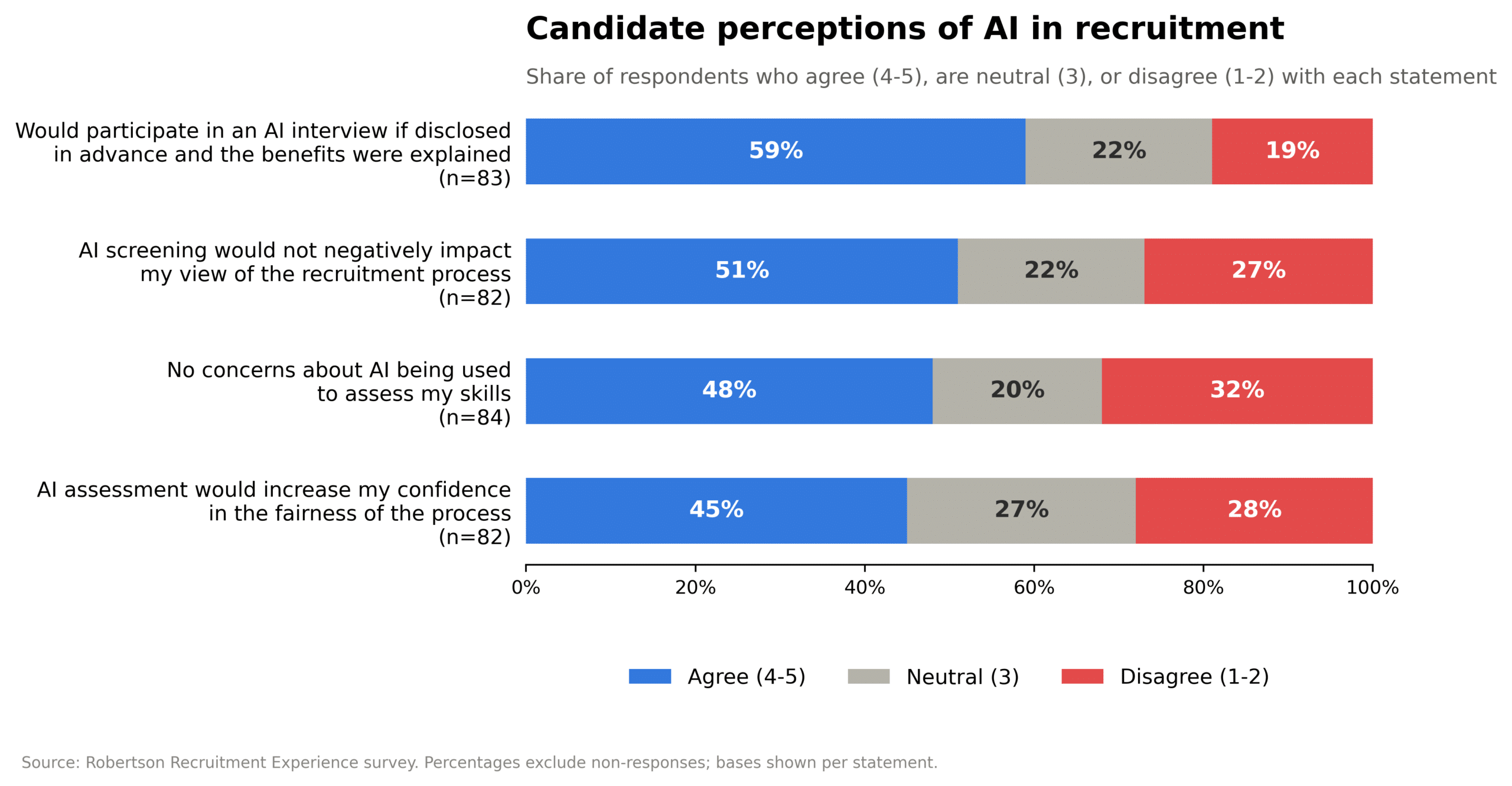 2.2 The biggest gap is explaining “what’s in it for me”
 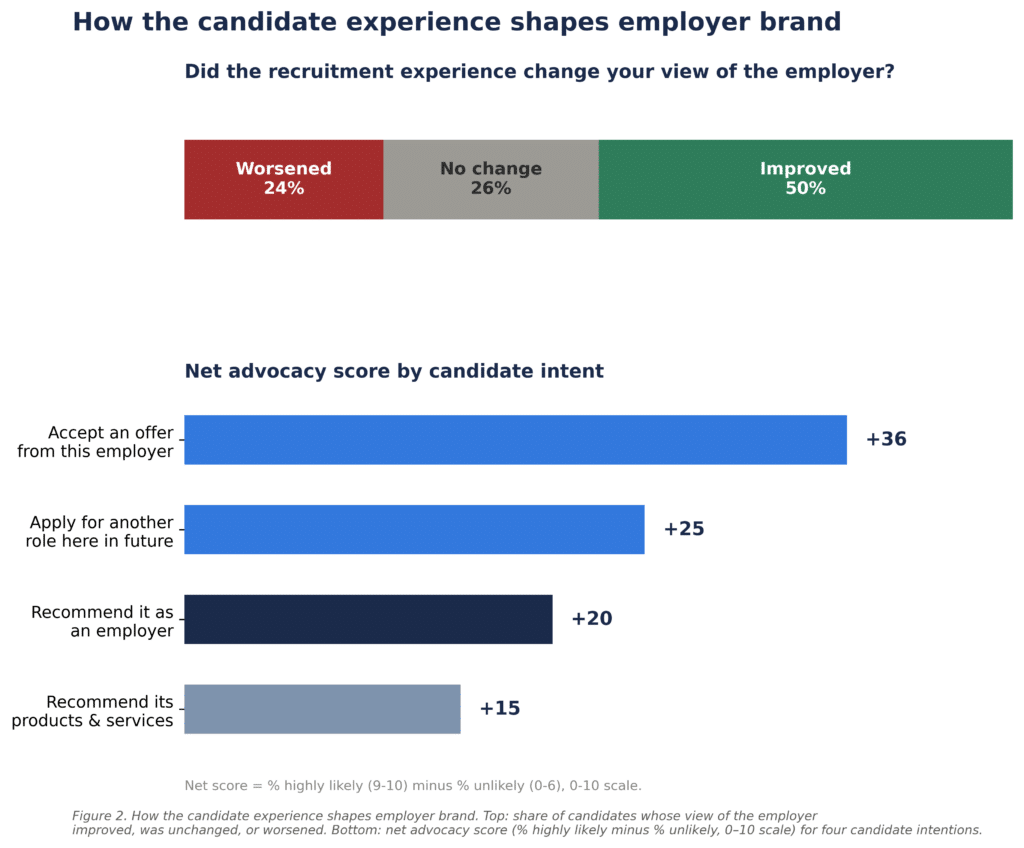 Figure 2. How the candidate experience shapes employer brand. Top: share of candidates whose view of the employer improved, was unchanged, or worsened. Bottom: net advocacy score (% highly likely minus % unlikely, 0–10 scale) for four candidate intentions.