

Summary
After conducting 15,000 AI-assisted virtual interviews for our Banking and Financial services clients, we’ve found that the business outcomes AI recruitment technology vendors promise have not materialized. Hiring volume has not increased. Cost per hire has not decreased. Quality of hire has not changed. And candidate completion rates have declined. On the positive side, we’ve seen improvement in candidate response times to initial outreach, we’re capturing a broader talent pipeline, and we’re achieving higher pre-screening throughput. AI interviewing does make recruiters more productive during the initial screening process–but it does not produce better hiring outcomes. This brief outlines what the data is telling us, the narrow gains we have seen, and what we believe CHROs and VPs of Talent Acquisition should consider before making new investments in AI talent acquisition platforms.
Robertson’s use of AI
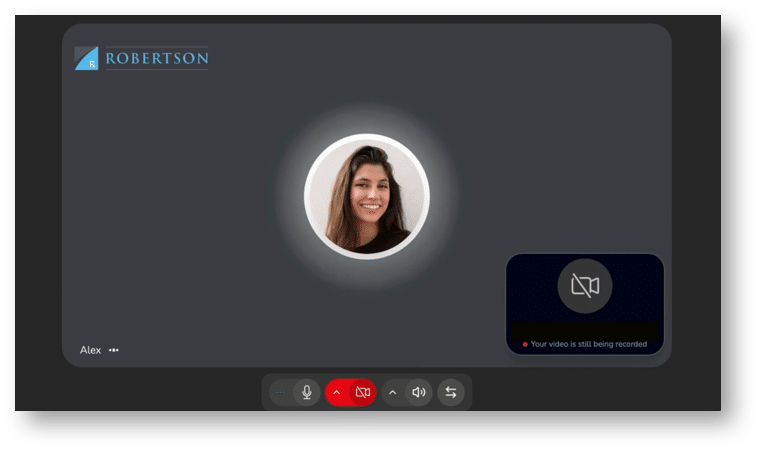
Robertson has piloted a variety of AI recruiting tools to improve our recruitment team’s effectiveness and productivity. As early adopters, we deploy a range of AI tools across our recruitment process and have contributed significantly to the development of one of the more sophisticated, human-like AI interview platforms on the market. After conducting 15,000 AI-assisted virtual interviews with our banking and financial services clients, we have not seen the business outcomes that vendors promise—or the outcomes we hoped to achieve. Hiring volume has not increased. Cost per hire has not decreased. Quality of hire has not changed. And candidate completion rates have declined. Part of what’s driving the decline is structural. The AI-assisted path adds steps to the recruitment process, and each additional step creates risk in both directions: more opportunity for recruiters to misuse the tool, and more opportunity for candidates to exit before ever engaging with a person. It is simply easier to walk away from a bot than from a recruiter.
This is not a marginal observation. It is a consistent operational reality across the work we do. The technology delivers what it is sold to deliver at the interface level. The broader recruitment outcomes it promises to deliver are not evident in our data.
What our data is telling us
Five findings that warrant attention:
- No increase in hires. Adding tools has not translated into more hires. Despite materially higher screening throughput, completed hires have not risen at a rate that justifies the per-hire economics of the technology. Faster screening of the same — or fewer — actual hires is activity, not productivity.
- Limited reduction in time-to-hire. Time-to-hire reductions tracked roughly one-third of the screening time saved. The remainder was absorbed by parts of the process — scheduling, hiring manager interviews, debriefs, offer cycles, background checks — that remain human-paced and human-bound.
- Cost per hire has not decreased. Costs per screen have dropped in some categories. Cost per hire — the metric that matters for the talent acquisition budget — has remained essentially flat once the full cost of AI integration, ongoing management, retraining, and exception handling is included.
- Rising candidate abandonment rate. We are observing a measurable increase in interviews that started but not finished. Our working hypothesis is that AI-mediated processes create additional “exit pathways” moments at which candidates. The lower psychological cost of leaving a conversation with a machine, perceived impersonality, and discomfort with the format are all plausible contributors. Whatever the cause, the effect is measurable and material.
- No difference across role-level. The conventional vendor belief — that AI works disproportionately well for high-volume, hourly, or lower-skill roles — is not supported by our data. Outcomes for hourly roles look broadly similar to outcomes for professional roles. This is significant because most enterprise AI talent business cases explicitly assume role-level segmentation as the source of ROI.
We do not want to overstate the negative findings. Three modest gains are worth acknowledging:
- Off-hours and overflow capacity improved, particularly during peak hiring cycles.
- Candidate response times to initial outreach improved measurably.
- Pipeline coverage in tight markets widened, as recruiter availability was no longer the binding constraint at the very top of the funnel.
These are real. However, they are not the gains the technology promises to deliver, and organizations expect. They are second-order benefits, but they are not what most AI talent acquisition business cases rest on.
The process redesign question
To the extent any ROI is realized on the implementation of AI tools, the single largest predictor in our data is whether the organization treated AI screening as a workflow upgrade or as a technology purchase. Like any successful technology implementation, organizations that redesigned hiring manager engagement, debrief cadence, and intake practices saw at least some realized benefit. Organizations that did not, did not. In either case, the gains did not approach what vendor models projected.
This is uncomfortable because it implies that AI is the easy part. The work – process redesign, manager training, governance – is what most organizations do not budget for and do not sequence properly.
Implications for investment decisions
For CHROs planning talent acquisition investments, four recommendations warrant consideration:
- Scope the business case to actual outcomes, not vendor projections. The relevant metrics are hiring volume, cost per hire, time to hire, quality of hire, and candidate completion rate. Throughput and cost per screen are not.
- Treat candidate abandonment rate as a leading indicator. A rising abandonment rate is a signal — of candidate experience erosion, of misfit between process and audience, or both. It will eventually show up downstream, but it is detectable earlier if it is being measured.
- Question role-level segmentation in vendor business cases. If a vendor’s projected ROI relies heavily on the assumption that AI works best for hourly or volume roles, test that assumption against independent operating data before underwriting it.
- Budget process redesign at parity with technology cost. In our experience, the realistic ratio is closer to 1:1 than the 1:4 most AI investment cases assume. Plan for a flat first year.
For organizations planning 2027 talent acquisition investments, the right question is no longer whether to deploy AI, but what to budget alongside it, what to measure, and what to expect.”
A note on methodology
Findings in this brief are drawn from Robertson’s RPO clients in financial services from January 2025 to January 2026. Comparisons are made against matched control cohorts using traditional screening over the same period. Quality-of-hire data reflects six- and twelve-month performance ratings provided by client partners. We are glad to walk client teams through the underlying data ranges in more detail under appropriate confidentiality arrangements.

